

Boosting NAD+ Function While Inhibiting CD38
The perfect stack or just more hype?
Key takeaways:
NAD+ is a coenzyme in every living cell that powers mitochondrial energy production, DNA repair, immune function, and cellular stress response
Levels decline 50% or more by age 60 due to increased consumption by CD38 (inflammation), PARP (DNA repair), and decreased production
This decline drives multiple problems of aging: fatigue, cognitive decline, metabolic dysfunction, and increased disease risk
I recently came across a couple of studies on simultaneously boosting NAD+ and, at the same time, decreasing CD38 with natural supplements.
What is NAD+?
Let’s start with a little background science on NAD+, and then I’ll get into the studies on CD38 inhibition.
NAD+ (nicotinamide adenine dinucleotide) is used by all plants and animals in cellular processes, including ATP (cellular energy) production. It is a niacin derivative necessary for multiple cellular functions -- without it, cells can't produce energy..
Cellular energy: In cellular metabolism, NAD+ shuttles electrons in redox reactions for ATP production. The majority of ATP production comes from processes in the mitochondria (the powerhouse of the cell). This is where NAD+ is essential - shuttling electrons in the Krebs cycle and electron transport chain.
Much of the focus on NAD+ is for cellular energy, but there’s another important role for NAD+….
CD38: Immune system using up NAD+
CD38, and a similar molecule, CD157, consume a lot of NAD+ in the body - especially in aging.1 CD38 is found as a surface receptor on immune cells. Both CD38 and CD157 are also involved in the immune response and neuroinflammation in the brain.2
CD38 uses up NAD+ by acting as an enzyme that catalyzes the degradation of NAD+ in order to use the metabolites as messenger molecules.
How do we get NAD+?
There are two main ways we get NAD+
It can be synthesized from niacin, which can be obtained from your diet or through the conversion of tryptophan. This is called de novo synthesis.3
NAD+ can be synthesized in a salvage pathway that recycles NR (nicotinamide riboside) or NMN (nicotinamide mononucleotide) to NAD+.
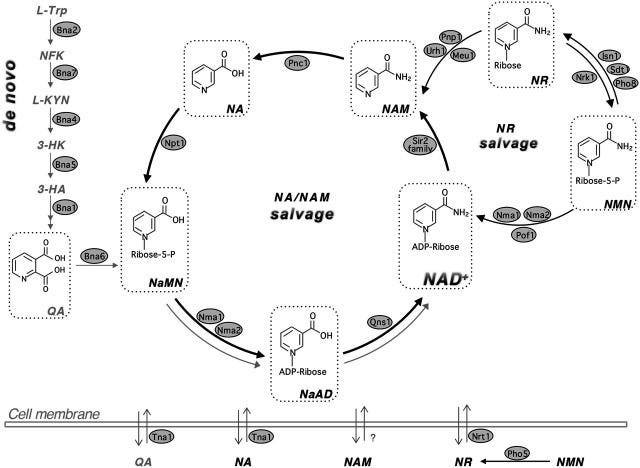
How CD38 and inflammation result in NAD+ depletion in aging:
CD38 is key to the decline of NAD+ in aging by depleting levels. Increased inflammation - inflammaging - causes increased CD38, which uses up more NAD+, causing a parallel decline in NAD+ levels. Increased cellular senescence in aging also causes increased CD38, with a subsequent decrease in NAD+.4
Here’s what it looks like:
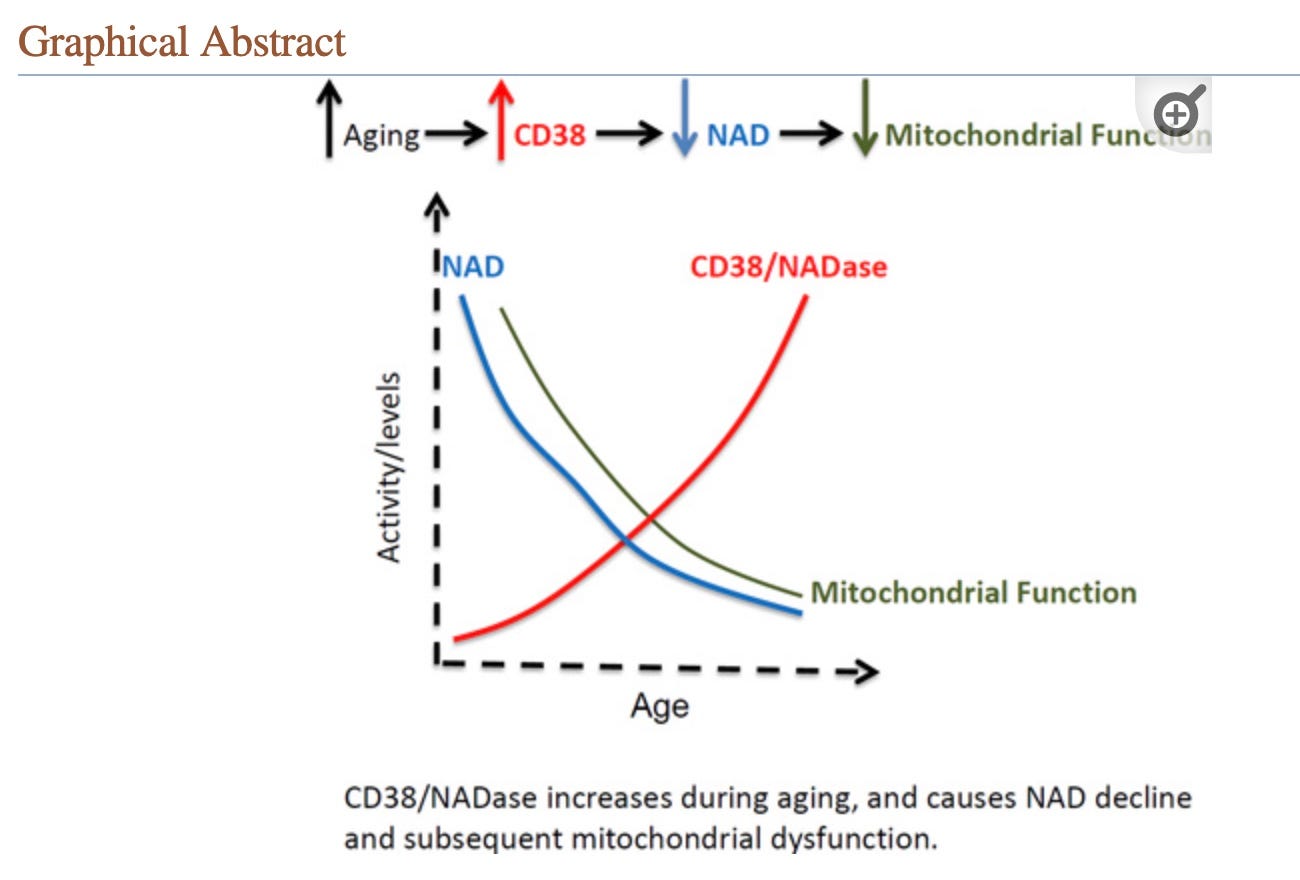
T cells, immune cells, endothelial cells, and smooth muscle cells all can produce CD38, and it is upregulated by proinflammatory cytokines, cellular senescence, steroid hormones, and in response to bacterial infections. CD38 is also upregulated in fibrosis.56
CD38 does a lot, including activating T cells, regulating calcium ions in the brain, inhibiting sirtuins, and limiting NAD availability in bacterial infections. So you don’t want to completely inhibit CD38, just prevent the excess rise in it.7
Boosting NAD+ while simultaneously inhibiting CD38:
A 2024 study on skin aging showed that simultaneously inhibiting CD38 while boosting NAD+ was better for skin health than either alone. The combination increased sirtuin activation, improved autophagy, and boosted mitochondrial functionality.8
There are two supplements to boost NAD+ levels in aging: NR or NMN. Which one is better is a matter of ongoing debate — and commercial interests — among researchers with financial stakes in each.
NR (nicotinamide riboside): TruNiagen is the patented version with good quality control, testing, and clinical trials. It is also expensive.
NMN (nicotinamide mononucleotide): There are multiple sources for NMN, and I suggest going with a brand name that you trust and that has 3rd party testing. I usually go with a powdered form of NMN because I don’t like to take too many capsules. I don’t mind the taste, but some people find it hard to handle.
Drop your favorite NR or NMN recommendation on this in the comments. I would love to know what works for all of you. The Amazon links above are just examples of what I’ve used - not necessarily a recommendation of the best.
There are several natural supplements that inhibit CD38.
Apigenin is a flavonoid that is a mild inhibitor of CD38. Animal research shows that apigenin decreases CD38 levels along with an increase in NAD+ levels.9 Apigenin is readily available as a supplement.
Quercetin is a flavonoid that inhibits CD38, and studies on it show that it may be synergistic with supplemental NAD.10 Quercetin can be found in capsules or powdered form, but note that it is yellow and will stain when using the powder.
Luteolin is another flavonoid that can inhibit CD38.11 It is also available as a supplement.
Enoxolone is another natural compound that has been shown to inhibit CD38.12 It is a component of licorice and derived from glycyrrhizic acid.
Researchers are looking at CD38 inhibitor drugs as well. For example, a small molecule referred to as 78c is a CD38 inhibitor that increases lifespan in mice by about 10%.13
So, how much difference does this actually make?
Multiple clinical trials show some benefits for heart health or specific biomarkers from NR or NMN, but the results aren’t spectacular. Personally, I find that it gives me a little more energy throughout the day. So this is one supplement that I keep in my rotation that I think likely has some benefits, but I don’t want to oversell this as the one thing that will cure death and aging. Adding a CD38 inhibitor makes sense, but talk with your doctor if you have questions on whether a supplement is right for you.
The reality is that a stack with an NAD+ booster and CD38 inhibitor is just one tool that may add some benefits for healthy aging.
https://www.ncbi.nlm.nih.gov/labs/pmc/articles/PMC7693531/
https://www.ncbi.nlm.nih.gov/pmc/articles/PMC7693531/
https://www.ncbi.nlm.nih.gov/pmc/articles/PMC4487780/
https://www.ncbi.nlm.nih.gov/pmc/articles/PMC8752031/
https://www.cell.com/iscience/fulltext/S2589-0042(20)31099-3
https://pmc.ncbi.nlm.nih.gov/articles/PMC8917930/
https://pmc.ncbi.nlm.nih.gov/articles/PMC8917930/
https://pubmed.ncbi.nlm.nih.gov/39513906/
https://pubmed.ncbi.nlm.nih.gov/23172919/
https://pubmed.ncbi.nlm.nih.gov/39513906/
https://www.sciencedirect.com/science/article/abs/pii/S0960894X11006512
https://pubmed.ncbi.nlm.nih.gov/39513906/
https://pmc.ncbi.nlm.nih.gov/articles/PMC9009115/
the NMN link is for the tru Niagen just FYI...
Great article and love the science. Important connection to decreasing CD38 so thank you for that. I would also love clarity on the link to GLUTATHIONE as so many people talk about NAD+ in the context of supporting/precursor to GLUT vs decreasing CD38. I'm sure you cover this in another article...
Also would reiterate to your readers that 3rd party testing and ISO certified labs are what you should look for in quality supplement.
Nadostat (also known in research as TNB-290) is also an interesting thing to keep an eye on.