

Aging at a cellular level
Different cell types age at different rates, and cell‑specific aging predicts disease susceptibility, resilience, and mortality.
A new study in Nature Medicine (Ding et. al., 2026) lets us look inside to see how aging occurs differently across cell types — and how that contributes to the diseases of aging, such as cancer, neurodegenerative diseases, and frailty.
Core ice: we don’t get old at the same rate across cell types and organs. Cell types age at different rates, so you can have old lung cells or old astrocytes in the brain, while the rest of your cells have a more youthful profile.
Researchers looked at over 7,000 plasma proteins measured in more than 60,000 people across a wide age range, and then used machine learning models to estimate the biological age of more than 40 cell types (neurons, immune cells, endocrine cells, astrocytes, muscle cells, etc.). They also had up to 15 years of follow-up data on disease occurrence and mortality. All in all, a huge data set and a massive endeavor that is giving us real insight into aging.
Let’s take a look at some of the really interesting findings in the study:
Big picture: About 25% of people in the study had accelerated aging in a single cell type, with a small percentage (1-3%) having accelerated aging in 10 or more cell types. Those with accelerated aging in 20 or more cell types were at a very high 15-year mortality risk. Extreme aging in muscle cells, neurons, or immune cells increased mortality rates more than in other cell types.
Gut barrier in younger crowd: In people under 60, accelerated aging showed up in intestinal goblet cells and ciliated cells in about 4-5% of people. (Intestinal goblet cells are responsible for the gut mucosal barrier - read more about why the gut barrier is essential for preventing autodigestion.)
Brain in old age: Accelerated age gaps show up in neuronal and glial cells in the over-85 crowd.
Healthy lifestyle = younger cells: Younger overall cellular age was found in people who didn’t smoke, slept 7+ hours a night, didn’t drink, and weren’t obese. People who smoked and were obese were more likely to have accelerated aging in multiple cell types.
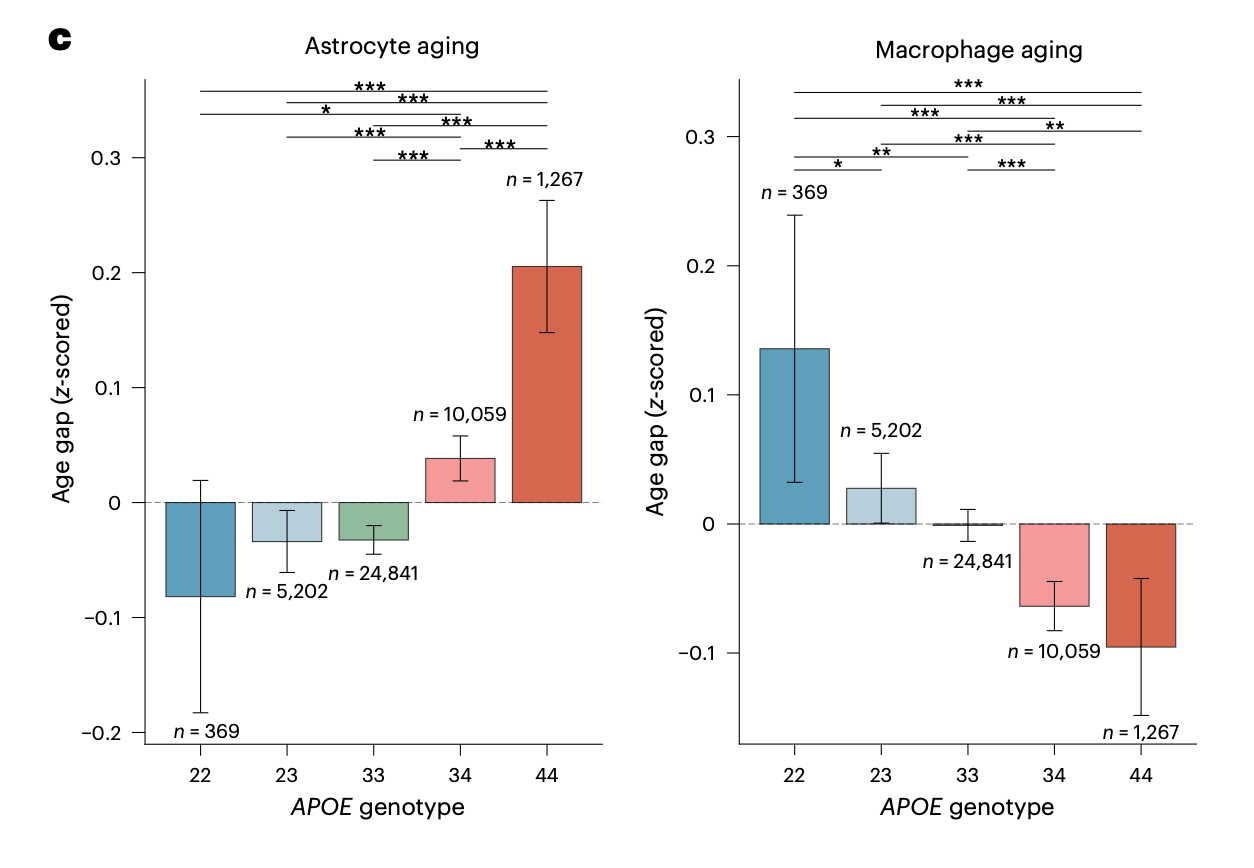
APOE4: APOE4 carriers showed older astrocytes, which tracked with increased Alzheimer’s risk. Astrocytes are the support cells for neurons, and many studies point to astrocytes being key in Alzheimer’s pathology. What was interesting, though, was that APOE4 carriers had younger macrophages, suggesting an enhanced immune vigilance. Other studies show that APOE4 is likely an evolutionary tradeoff - better immune response to certain pathogens (increasing early survival), but with the brain function deteriorating in late life.
Astrocyte age turned out to be the strongest predictor for Alzheimer’s risk. People with extreme astrocyte aging were at a 12-fold higher risk of Alzheimer’s. Notably, none of the APOE E4/E4 carriers who had youthful astrocytes developed Alzheimer’s, and only 1.8% of the E3/E4 carriers with youthful astrocytes were diagnosed with Alzheimer’s. Even among people without an E4 allele, extreme astrocyte aging increases Alzheimer’s risk by almost 5-fold.
APOE2: The APOE2 type is protective against getting Alzheimer’s. This study showed that APOE2 had an opposite effect as seen in APOE4 — they had young astrocytes, but old macrophages.
ALS: People who had extreme aging in their skeletal myocytes were 7 times more likely to have ALS. To put numbers to it, 93% (53 of 57) of the individuals with extreme aging skeletal myocyte profiles had an ALS diagnosis.
Lungs: Extreme aging in alveolar type 2 cells turned out to be a prognostic risk factor for lung cancer. Combined with smoking, extreme aging in alveolar type 2cells and respiratory epithelial cells increased lung cancer risk by 15-fold (58% higher than smoking alone). For COPD, extreme aging in both alveolar type 2 cells and respiratory epithelial cells was also prognostic.
Heart: Extreme aging in muscle cells and fibroblasts was found to be prognostic for heart failure.
My takeaways
This study puts hard numbers and data behind what we kind of already knew from both life experience and other studies. Extreme aging in skeletal muscles turns out to be one of the biggest mortality risk factors, with brain aging in astrocytes and neurons a close second. This goes along with the idea that motor neuron function may be the hard limit on lifespan. And the APOE and Alzheimer’s findings strongly back up what a lot of recent studies show about astrocyte health and the blood-brain barrier being key to healthy aging.
The whole study is open access and worth reading in more depth than what I’ve covered here. Check it out when you have the time to dig into the details.
The finding that youthful astrocytes tracked lower Alzheimer's risk more strongly than APOE genotype is genuinely striking.
My training is in the methylation-array world these aging signatures grew out of, so my instinct is to hold two things apart here.
The first is that this is prognostic association, cross-sectional prediction, not evidence that a young astrocyte signature protects anyone or that you can move it and change the outcome. The second is the perennial clock question of whether the signal reflects real underlying biology or just clock-reactivity to the same upstream drivers.
I keep landing on the clinical translation problem: for a reader worried about their heart, does a cell-specific or proteomic aging read add decision-relevant information over apoB, a calcium score, and blood pressure, or is it a beautiful biomarker still waiting for its actionable use? Curious where you would draw that line.